7 hr
Samana Humpback Whale Watching & Cayo Levantado Day Trip
- Expert local guide
- Small group
- Skip-the-line access
- Free cancellation
Whale Watching Samana Dominican Republic — Humpback Boat Departures from Puerto Principal
Bay of humpbacks in winter light, breach and song at dawn.
Compare fares, pick the fit — all bookings are mobile-voucher and eligible for free cancellation where shown.
7 hr
3 hr
12 hr 30 min
Every visit begins with the required marine sanctuary entrance bracelet, but the real decision for whale watching samana dominican republic trips is which boat tour tier to add on top of it. First-timers generally choose between a whale-watching-only half-day departure and a full-day combo that pairs the sanctuary waters with Cayo Levantado beach time.
| Whale-Watching Half-Day (Sanctuary bracelet + boat only) |
Top pick Combo with Cayo Levantado (Sanctuary bracelet + island lunch) |
Full-Day with Hotel Transfer (Sanctuary bracelet + pickup) | |
|---|---|---|---|
| What's included | Sanctuary bracelet, boat, guide | Sanctuary bracelet, boat, guide, buffet lunch on Cayo Levantado | All combo inclusions plus round-trip hotel transfer |
| Duration | Roughly 3 hours on water | Full day, boat plus island stop | Full day, transfer adds pickup time |
| Meeting point | Puerto Principal, Av. La Marina, Samana | Puerto Principal, Av. La Marina, Samana | Hotel lobby, then Puerto Principal |
| Lunch/beach time | — | Dominican buffet lunch, swim time on Cayo Levantado | Dominican buffet lunch, swim time on Cayo Levantado |
| Typical price range | Lowest of the three tiers | Mid-range, most booked option | Highest, covers transfer logistics |
| Best for | Time-limited or budget-focused visitors | First-time visitors wanting whales and a beach stop | Travelers without their own transport to Samana |
| See tickets & prices |
Verdict: Choose the Cayo Levantado combo for a balanced first samana whale watching tour, the half-day option if time is tight, or the full-day tour with hotel transfer if arranging your own transport is inconvenient.
Worth it for most visitors to Samana Bay
The math is simple. Whale watching samana dominican republic starts with a 100 DOP sanctuary entrance bracelet per person, then you pay a licensed operator on top for the actual boat. That bracelet is not the tour price; it is the marine sanctuary access fee that funds humpback protection in Samana Bay. For that combined outlay you get near-guaranteed sightings during a season that averages over 1,500 humpbacks, with breaching, tail-slapping, and singing males often within meters of the boat. Few wildlife excursions offer those odds. Samana Bay whale watching tours pay off best for first-timers, photographers, and anyone who has never seen a humpback in the wild. It is less compelling if you have already done premium boat trips elsewhere, since popular sighting spots can gather several vessels at once and thin the sense of solitude you might be paying for.
Bottom line: For the price of a bracelet plus a boat seat, whale watching samana dominican republic tickets buy some of the best humpback odds anywhere, and that verdict lands worth it for nearly everyone.
Hand-picked experiences loved by thousands of travelers
11.5 hours
Free Cancellation
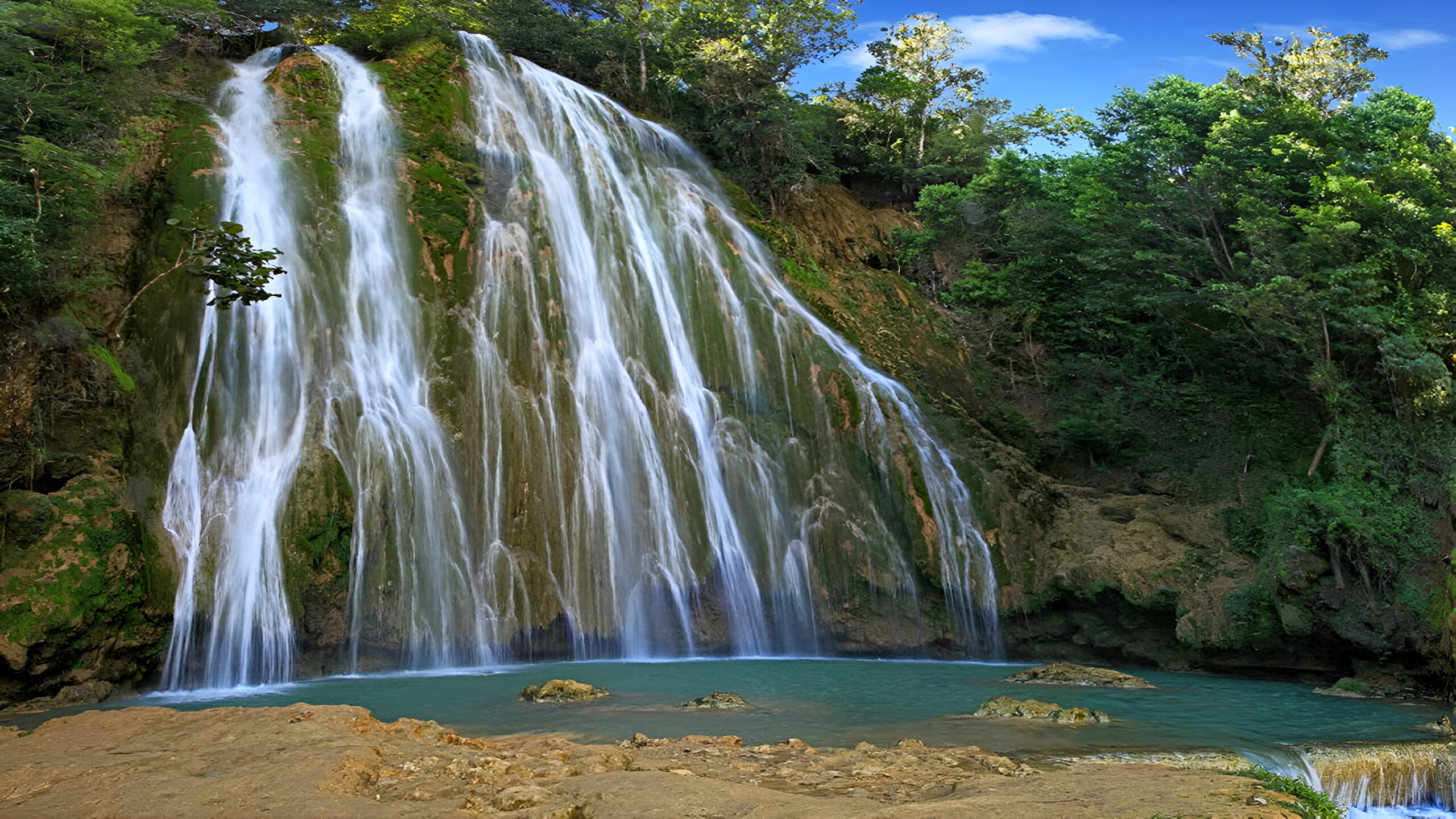
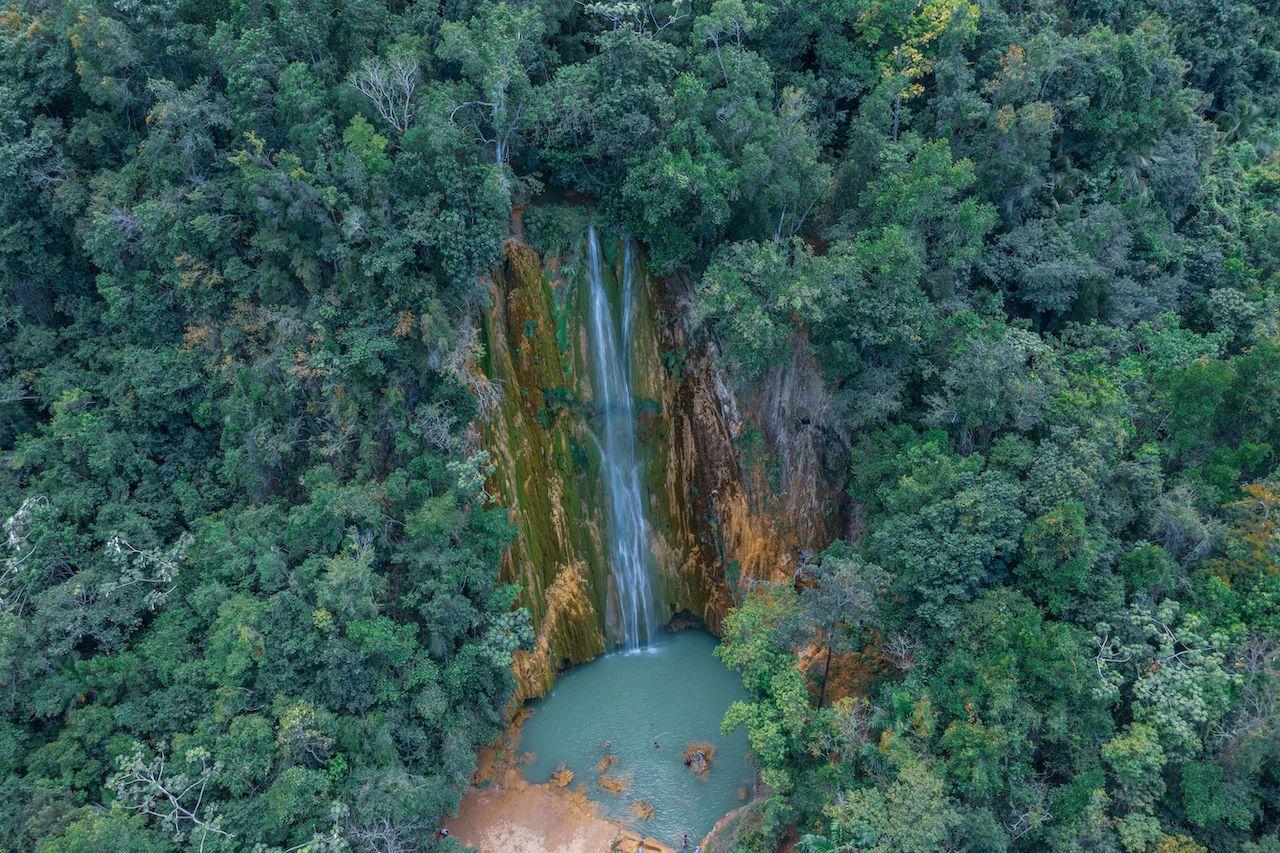
Explore El Limón waterfall, ride through the jungle, and relax on the pristine beaches of Cayo Levantado.
10 - 12.5 hours
Free Cancellation
Discover Samaná's lush mountains, the stunning El Limón waterfall, and the white sands of Bacardi Island on this complete tropical adventure.
13 hours
Free Cancellation
Discover Samana’s wild beauty with an epic journey featuring whale watching, jungle horseback riding, and waterfall swimming.
Arrive at Av. La Marina, collect entrance bracelet and confirm booking with the operator
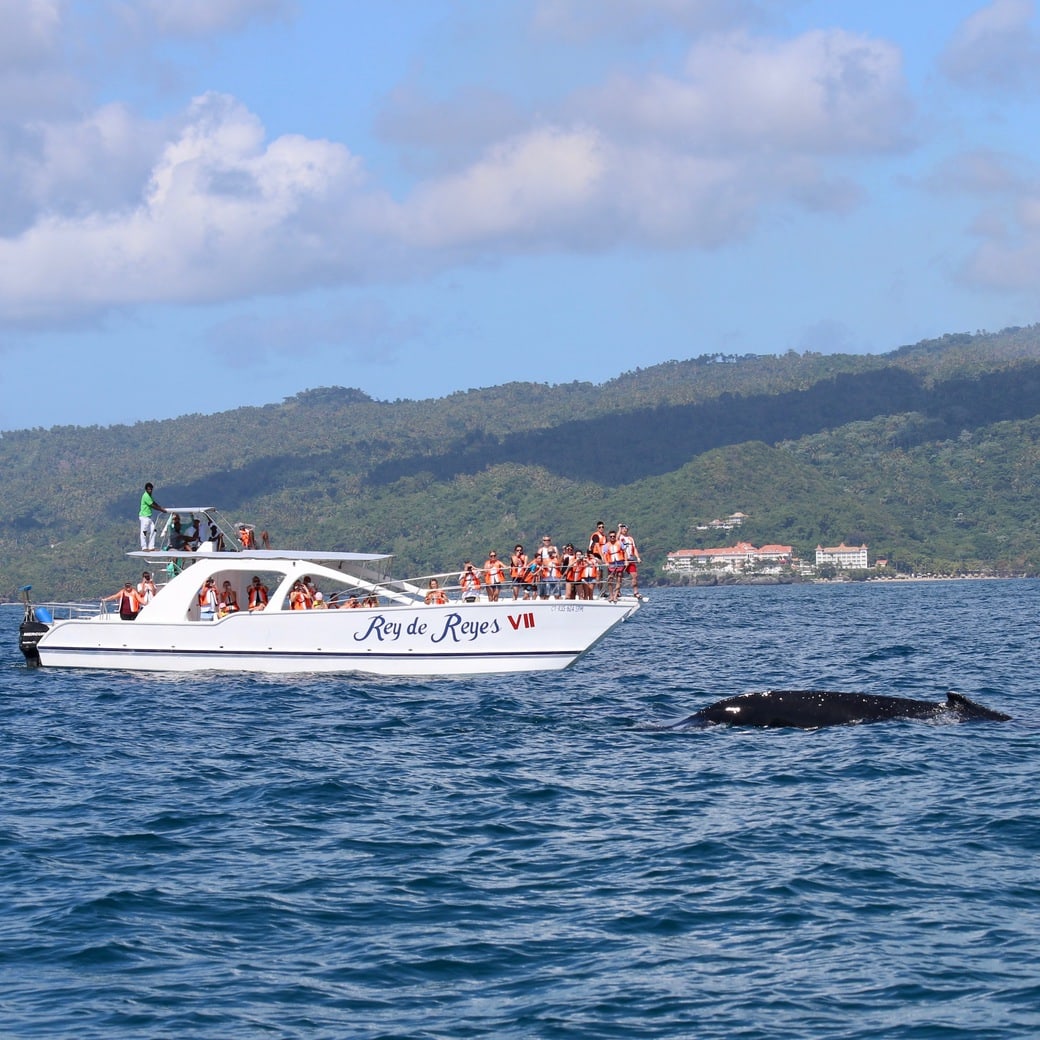
Life vests distributed, safety briefing given before departure into Samana Bay
Boat cruises the bay and toward the Marine Mammal Sanctuary following spouts and breaches
Onboard guide narrates whale behavior while the boat holds the required distance from pods
Boat heads back to Puerto Principal, concluding the whale watching Samana Dominican Republic tour
The core protected area where boats search for humpback whales, spanning the calm inner waters of the bay before opening toward the Atlantic. It forms part of the wider Silver Bank and Navidad sanctuary complex recognized as one of the Caribbean's key humpback breeding grounds.
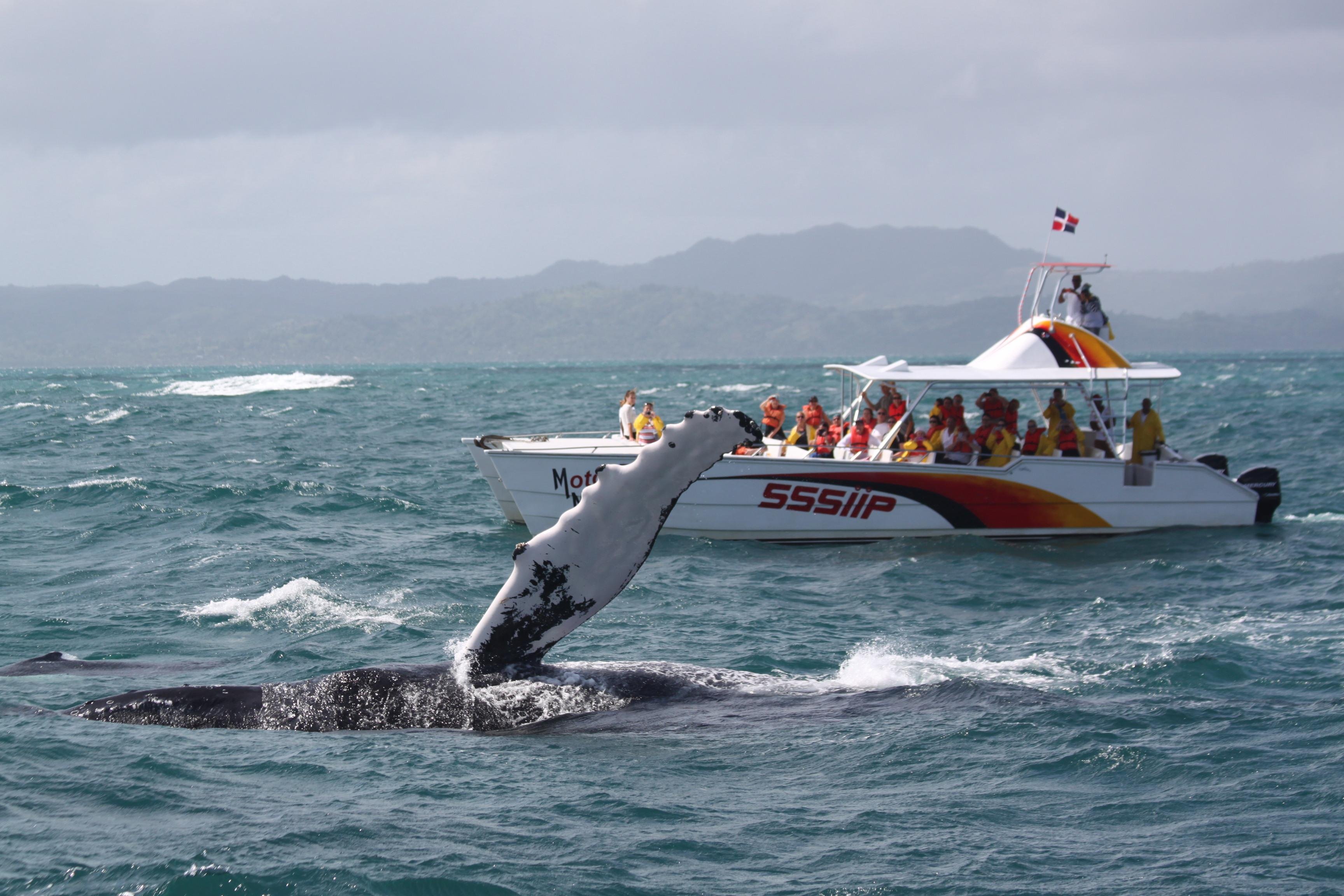
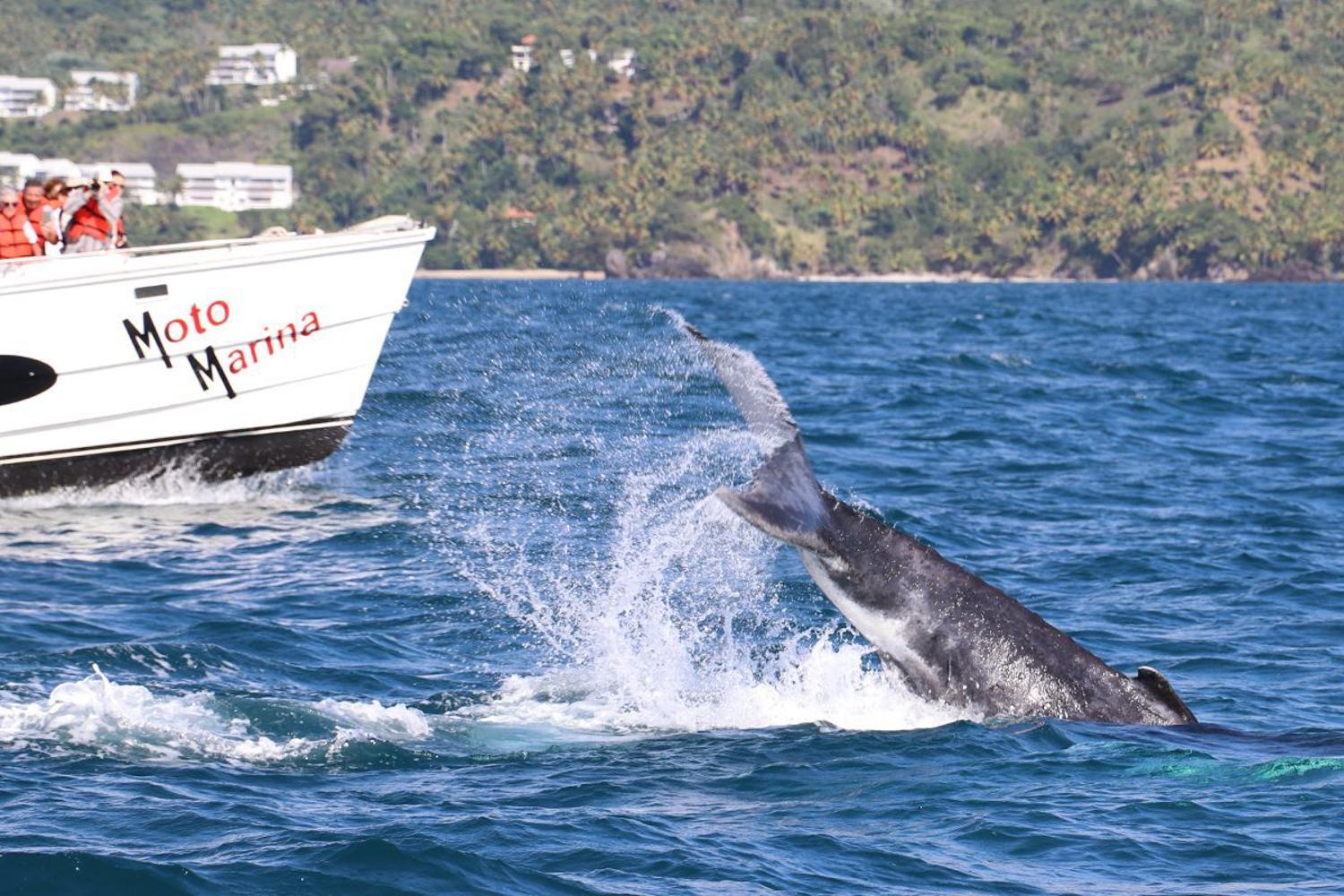
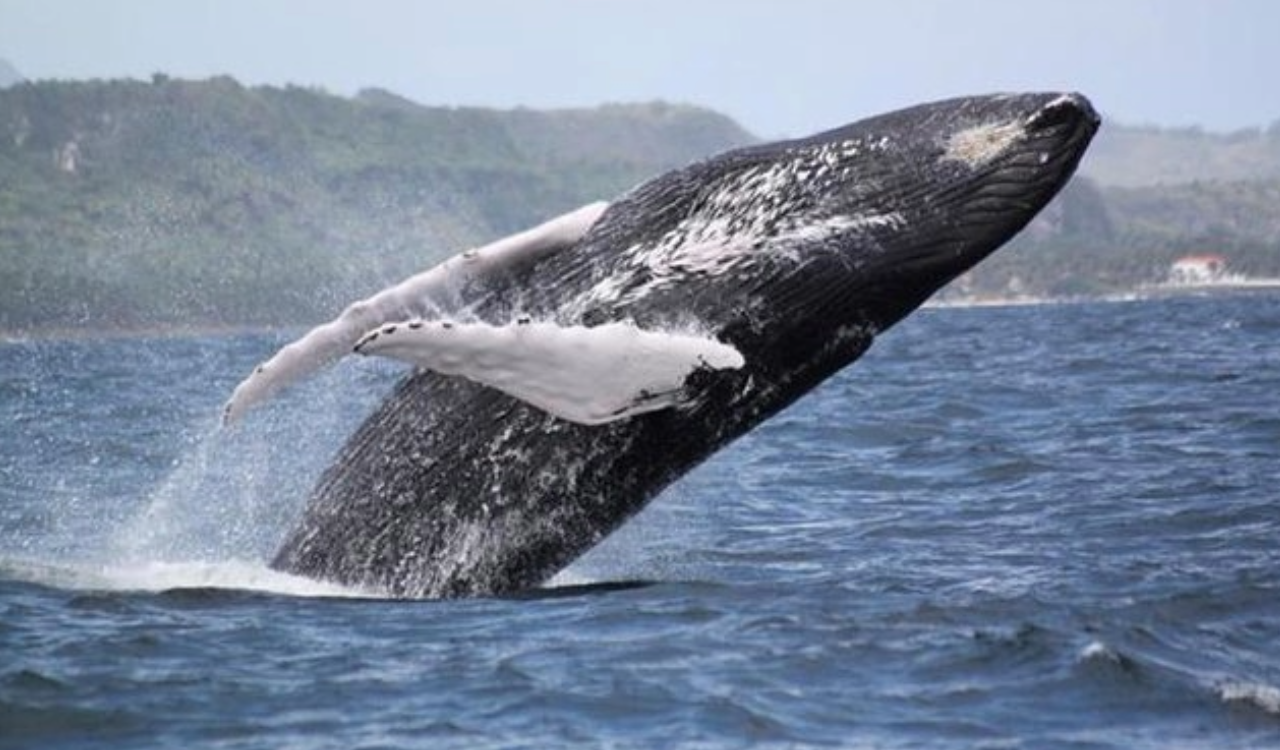
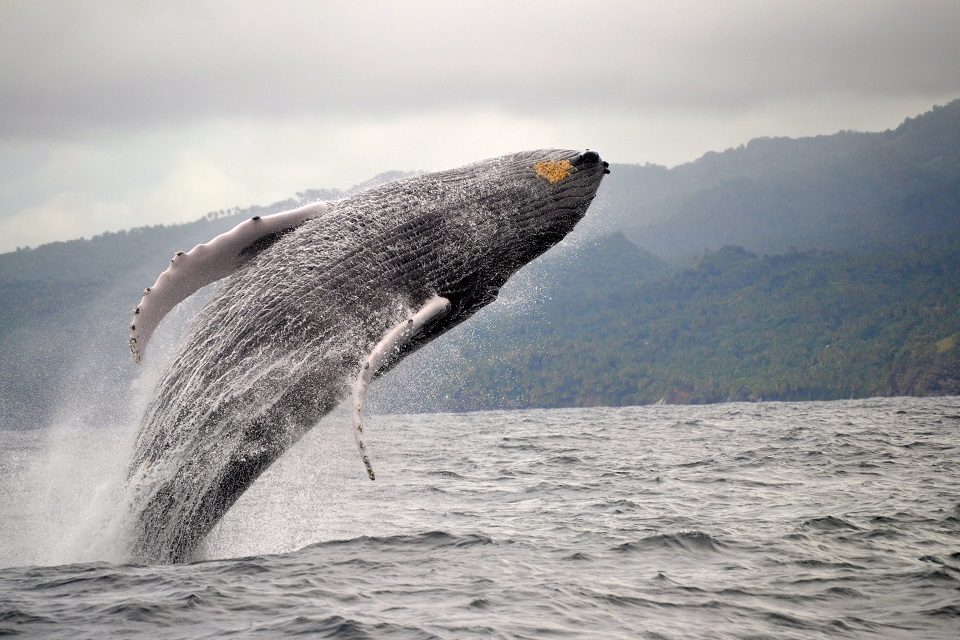
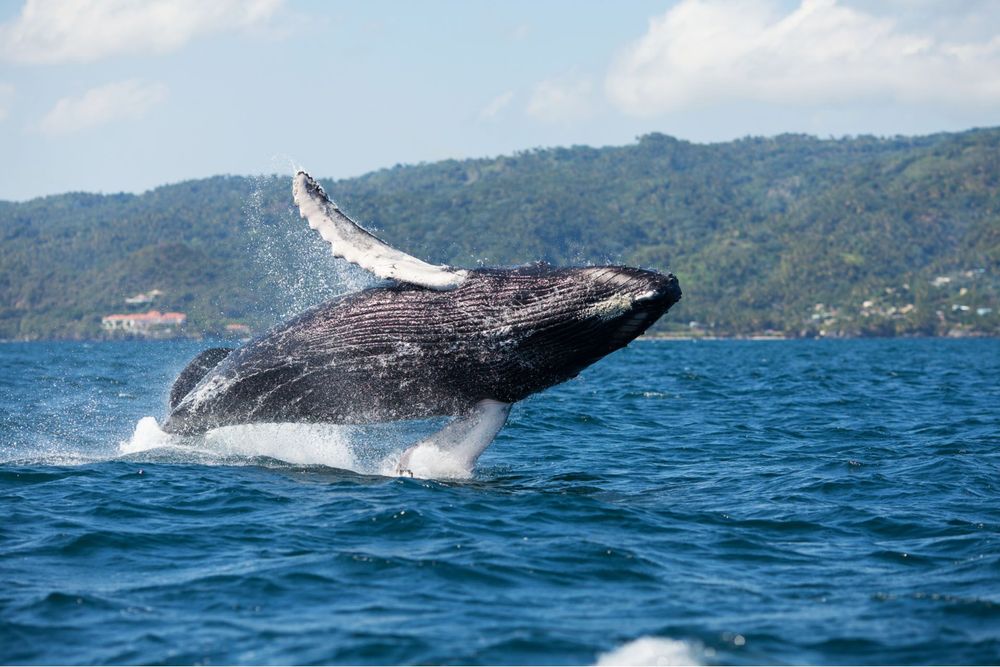
You gather at Puerto Principal on Avenida La Marina while the harbor is still cool and the light is low. You collect your marine sanctuary bracelet, step down onto the dock, and find a seat on the open deck as the boat eases past the fishing fleet and the small bridge to the town's islets. Within twenty minutes the port skyline shrinks behind you and the water widens into open bay. Then the first blow appears — a column of vapor hanging above the surface, followed by the dark arc of a back rolling forward. The captain cuts the engine to the required distance and lets the boat drift. You wait. A humpback surfaces, exhales with a sound like a released valve, and slides under, its flukes lifting for a long moment before the dive. Somewhere off the bow, a calf breaks the surface beside its mother. You pass the hydrophone around and hear it: the eerie, looping song of a courting male, threaded through the hull. Between sightings you scan the horizon toward Cayo Levantado, learning to read the water for the next spout. A breach, when it comes, arrives without warning — forty tons launching sideways in a burst of white spray. Your whale watching samana dominican republic morning ends as the boat turns back toward the malecón, the peninsula's green ridgeline rising ahead, salt drying on your arms.
All the details about your upcoming adventure in one place
Each winter, thousands of North Atlantic humpback whales migrate into the warm waters of Samaná Bay to breed and calve, making whale watching samana dominican republic one of the Caribbean's premier marine wildlife experiences. Departing from the Samaná peninsula, whale watching samana dominican republic tours carry you across the bay aboard licensed vessels where naturalist guides help spot breaching adults and their calves. These observación de ballenas outings are among the most rewarding Samaná bay tours for anyone drawn to the region's rich humpback migration.
Each winter, roughly 3,000 North Atlantic humpback whales converge on the warm shallows of Samaná Bay, having traveled some 5,000 kilometers south from feeding grounds off Iceland, Greenland, and the Gulf of Maine. They come to breed and calve in the same protected water their ancestors have used for centuries, and their arrival transforms this quiet corner of the Dominican Republic into one of the most reliable marine mammal gatherings on Earth. Whale watching samana dominican republic draws travelers precisely because the bay concentrates so many animals in so small a space. The Samaná Peninsula sits on the northeast coast, a long green finger of land fringed by coconut palms and framed by the Cordillera Septentrional. Santa Bárbara de Samaná, the small port town at its heart, was founded in 1756 by Canary Island settlers and later absorbed families of freed African Americans who arrived in the 1820s, giving the town a distinct cultural weave still audible in local surnames and Protestant chapels. The bay itself, sheltered and shallow, offers the calm, temperate water that nursing humpback mothers require. Protection came formally in 1986, when the surrounding waters were designated the Sanctuary for the Marine Mammals of the Dominican Republic — one of the earliest such reserves in the wider Caribbean. The sanctuary spans thousands of square kilometers, encompassing Samaná Bay, the offshore Silver Bank, and Navidad Bank, and it governs how close vessels may approach and how many boats may observe a single pod at once. These rules explain why an avistamiento de ballenas samana outing feels orderly rather than chaotic: the regulations are older than most of the operators. What visitors witness is behavior, not merely presence. Male humpbacks produce the long, structured songs for which the species is famous, and in the confined acoustics of the bay those songs carry through a boat's hull. Females shepherd newborn calves, which surface every few minutes to breathe, while competing males breach and slap their pectoral fins in displays that can lift forty tons of animal clear of the surface. A samana bay humpback tour is as much an exercise in listening as in looking. Beyond the whales, the peninsula rewards curiosity: the cascading Salto El Limón waterfall inland, the mangrove channels of Los Haitises National Park across the bay, and the sandbar island of Cayo Levantado just offshore. The town's malecón, its fishing boats, and its 19th-century architecture anchor the whales within a living place rather than a spectacle staged for outsiders. For many, whale watching samana dominican republic is the reason to come, but the surrounding landscape is the reason to stay, and the sanctuary's founding principle — observation without interference — shapes every hour spent on the water.

In the confined acoustics of the bay, a male humpback's song carries straight through a boat's wooden hull.
Wear quick-dry clothing, a swimsuit under layers, and closed-toe water shoes for boarding the boat at Puerto Principal. A light waterproof jacket is recommended since spray off Samana Bay can soak passengers even on a calm morning during a whale watching Samana Dominican Republic trip.
Bring only a small dry bag or backpack; boats departing Av. La Marina have limited stowage and no secure lockers on board. Staff conduct a brief visual check of bags before boarding to confirm no glass containers or prohibited items are carried into the marine sanctuary.
Photography and video are encouraged from the boat deck, though the DR's marine mammal regulations require vessels to stay roughly 80 meters from whales, so a zoom lens captures better detail than a wide shot. Drones and personal watercraft are not permitted near the whales inside the Samana Bay Marine Mammal Sanctuary.
Children are welcome on most whale watching Samana Dominican Republic tours, with life vests sized for young passengers provided by operators. Families with very young children may prefer the shorter half-day option to limit time on open water.
Boarding ramps and gangways at Puerto Principal vary by boat and tide level, so travelers with limited mobility should notify the tour operator in advance to arrange assistance. Most vessels have open deck seating rather than fitted wheelchair spaces.
Bottled water, soda, and light snacks such as coconut are typically provided on board by the operator, and outside food in sealed containers is generally allowed. Glass bottles and alcohol beyond what the crew supplies are not permitted on the boat for safety reasons.
Morning departures only, calmer seas
No sanctuary departures
Busiest weekday, book early
No sanctuary departures
Popular with weekend travelers
Best arrival 08:00–09:00 for calmer seas and peak whale activity
location
Car · 2.5–3 hr · Toll approx. $11 USD
Drive via the Samana Highway (DR-7) from Santo Domingo, roughly 2.5 hours, or from Puerto Plata via Sanchez in about 3 hours. Parking is available near Av. La Marina close to Puerto Principal.
Taxi · 10–15 min within town · Approx. 50–100 DOP
A local carro publico (shared taxi) can be taken from anywhere in Samana town to Av. La Marina or 'el puerto'.
Walk · 5–15 min · Free
Travelers staying near the Samana waterfront can walk directly along Av. La Marina to the dock area.
Public transport · 30–45 min from Las Terrenas · Approx. 100–150 DOP
Guaguas (shared vans) connect Samana to Sanchez and Las Terrenas, with a short taxi or walk to the port from the town center.
Trips booked through the Samana Bay Marine Mammal Sanctuary operators can typically be rescheduled or refunded if canceled due to poor weather or insufficient sightings, subject to each operator's terms. The 100 DOP marine sanctuary entrance bracelet fee is non-refundable once issued, regardless of tour outcome.
Recommended time
3-8 hours
Boats depart from Puerto Principal between 08:00 and 09:00, and this early start defines the whole day: seas are calmer, whales are more active, and captains beat the midday heat and the choppier afternoon chop that builds later on. A straightforward whale watching samana dominican republic outing runs about 3 hours if it is just the boat trip and sanctuary bracelet check-in, while tours pairing the sighting with lunch and beach time on Cayo Levantado stretch to a full 7-8 hour day. Add time if your boat waits its turn in the sanctuary rotation zone, since only a few vessels view the same pod at once; subtract time if you book a whale-watching-only option with a quick return transfer. Queueing is mostly at the dock before the 08:00-09:00 departure window, not once you are on the water.
Weather · crowds · average price — dots go green to amber to red as each metric rises.
Mid-to-late January marks the start of the season as the first solitary males arrive in Samana Bay. Seas are typically calmer earlier in the month with lighter crowds than February.
Considered peak season, with the highest concentration of humpback whales and courtship displays. Boats fill up quickly and advance booking is recommended.
Whale numbers remain strong into early March before tapering toward the March 31 season close. Weather stays warm with occasional brief showers typical of the Caribbean dry season.
Outside the official whale season, no whale watching tours depart from Samana Bay, as humpbacks have returned north to Atlantic feeding grounds.
February is peak season for whale watching Samana Dominican Republic tours, and boats departing Puerto Principal often sell out days ahead.
Boat-provided binoculars are often shared among passengers, so packing a personal pair helps you follow distant spouts and tail slaps.
The 100 DOP marine sanctuary bracelet fee is collected at the dock and is easiest to pay with small Dominican peso notes.
Swells on Samana Bay tend to build after midday, so operators favor the 08:00–09:00 departure window for a smoother ride.
Many whale watching Samana Dominican Republic tours combine a stop at Cayo Levantado for a swim, making it worth confirming which package includes the island visit.
Tours run strictly within the January 15 – March 31 window set by the Dominican Ministry of Environment, so trips booked outside these dates will not include whale sightings.
Av. La Marina, Santa Barbara de Samana 23000, Dominican Republic
Main departure dock for most whale watching operators
Get directionsAv. La Marina, Samana, Dominican Republic
Several operator offices line this stretch near the port
Get directionsThe story of whale watching samana dominican republic begins in 1985. That year, Canadian expatriate Kim Beddall organized the first commercial excursions into Samaná Bay. She had identified the humpback whales gathering on the Silver Bank breeding grounds. Her small operation seeded an industry. Demand rose quickly through the late 1980s. Growth outpaced oversight. By the early 1990s, dozens of vessels crowded the bay each morning. Boats jostled the humpbacks. Calving pairs were harassed. In 1994, operators and authorities drafted the bay's first voluntary guidelines, capping vessel numbers, fixing approach distances, and staggering departure times. The measures were imperfect but decisive. They marked the shift from spectacle to stewardship, and the earliest whale watching samana dominican republic tours began to follow written rules. Regulation hardened next. The Centro para la Conservación y Ecodesarrollo de la Bahía de Samaná (CEBSE), founded in 1989, took a leading role in monitoring. After the Ministry of Environment formed in 2000, a co-management system emerged, pairing state enforcement with CEBSE's local science. The sanctuary bracelet, licensing, and observer programs date from this framework. Anyone buying whale watching samana dominican republic tickets today funds that structure. The defining milestone came in 2015. The Sanctuary for the Marine Mammals of the Dominican Republic signed a sister-sanctuary agreement with the Stellwagen Bank National Marine Sanctuary off Massachusetts. The same humpback whales migrate between both waters. The pact linked breeding-ground protection in the Caribbean with feeding-ground protection in New England, sharing photo-identification catalogues and research. It gave the samana whale watching excursions an international scientific backbone. What survives is a regulated, co-managed refuge. The migration, the enforcement, and the cross-hemisphere partnership remain visible in every licensed whale watching samana dominican republic tour that leaves Puerto Principal. Kim Beddall's early boats have become a conservation model. The bay that once risked being loved to excess is now a protected corridor for the North Atlantic humpback.
Kim Beddall launches the first commercial whale-watching trips in Samaná Bay.
CEBSE is founded to coordinate conservation and ecodevelopment of the bay.
Operators adopt the bay's first voluntary vessel and approach guidelines.
A national Ministry of Environment forms, enabling formal co-management.
Sister-sanctuary agreement is signed with Stellwagen Bank in Massachusetts.
Visiting whale watching samana dominican republic with children works best as a half-day outing built around calmer water and a beach break, since a 3-4 hour boat trip alone is a long stretch for younger kids. Choosing the right vessel and pacing the day around Cayo Levantado makes the difference between a smooth morning and a rough one.
Book a catamaran rather than a small lancha or yola: catamarans sit more stable in Samana Bay chop, have shaded decks and space to move around, which matters far more for kids than being at the front for photos.
Give children motion-sickness tablets or bands before boarding, keep them seated mid-boat away from the bow spray, and pack crackers and water since choppy stretches are common on the outbound leg.
Split the outing into two calmer chunks rather than one long cruise: roughly 90 minutes to two hours on the water for whale sightings, then unwind on the beach at Cayo Levantado so kids aren't stuck sitting still the whole time.
Toddlers and children under about 6 often struggle with the rocking and engine noise; kids from around 7 up generally handle the whale watching samana dominican republic tour better and engage more with the naturalist commentary.
Onboard toilets exist on most catamarans but are basic, so use restrooms at the port before departure; Cayo Levantado has proper bathrooms and changing areas for the beach portion.
Bring reef-safe sunscreen, hats, a dry change of clothes for the beach stop, and a light jacket, since open decks get breezy even in warm weather.
Boats for whale watching samana dominican republic tours don't serve meals on board, so most people either grab a quick bite beforehand on Av. La Marina or eat included beach lunch if their tour bundles a Cayo Levantado stop.
Grilled fish, chicken and rice plates served steps from the sand on Cayo Levantado (Bacardi Island); many combo whale watching samana dominican republic tour packages route lunch here, so midday gets busy fast.
Dominican and international plates with vegetarian options a short walk from Puerto Principal; good for a sit-down breakfast before an early boat or dinner after returning.
Budget-friendly fish filet and pork dishes near the marina, popular for a fast pre-departure breakfast without the wait of pricier spots.
Handmade pasta and thin-crust pizza with harbor views across the boulevard, a relaxed option if returning boats run late for lunch.
Spanish-style tapas and seafood on a terrace overlooking the Malecon and marina, suited to a slower post-tour meal rather than a quick stop.
Real experiences from real travelers
We booked a morning whale watching samana dominican republic tour out of the town harbor and had two humpbacks surface maybe thirty meters off the bow. The captain cut the engine and we just drifted while they rolled at the surface. Bring a light jacket, the wind off Samaná Bay was cooler than I expected in March.
The Samaná Bay was glassy calm when we headed out around eight in the morning and we saw a mother and calf within twenty minutes. Our guide explained the humpback migration and pointed out spouts before we could even spot them. One of the better wildlife trips I have done in the Caribbean.
A whale watching samana dominican republic tour is not something to rush, so I was glad we picked the first departure. The light over the water was soft and gold and a whale slapped its pectoral fin repeatedly right beside us. The naturalist on board spoke Spanish, English and a little Portuguese which helped our group.
We saw three or four humpbacks over about two hours, though the swell past the harbor mouth made the ride bumpy and a couple of people felt queasy. Sit toward the middle of the boat if you are prone to seasickness. Still a solid whale watching samana dominican republic experience and the crew clearly knew where to look.
The Samaná humpback whale tour left Santa Bárbara harbor just after sunrise and the sea was mirror flat. A full breach happened close enough that we heard the splash and felt the spray. Our guide kept the boat at a respectful distance which I appreciated.
Watching humpbacks in Samaná Bay from a small catamaran felt intimate compared to the bigger vessels around us. We had gentle sun most of the trip and a whale surfaced so close I could see the barnacles on its head. The Samaná Dominican Republic whale watching tours run in the mornings and I would take the earliest one again.
By late December the bay was busy with whales and we counted at least six over the outing. The captain of our whale watching samana dominican republic tour explained the singing behavior of the males which was fascinating. Water was calm and the peninsula scenery behind us made the whole morning.
We nearly missed out because the whale watching samana dominican republic tickets for the morning slots sell fast in high season. Once out on the water we were rewarded with a tail-slapping humpback and a calm sunny bay. Bring water and sunscreen, there is little shade on deck.
Even near the tail end of the season we spotted a pair of humpbacks moving slowly through Samaná Bay in warm midmorning light. Our guide narrated the whole time and helped everyone get a clear view. A memorable look at these gentle giants and the crew handled the boat carefully.
The Samaná whale watching tour had a marine biologist aboard who tracked spouts and explained the humpback breeding grounds. Sea was a bit lively but the sightings more than made up for it. We had one whale breach fully three times in a row against the morning sun.
Everything you need to know for your journey
Boats depart Monday, Tuesday, Thursday, Friday, and Sunday from 08:00 to 13:30; the sanctuary is closed Wednesday and Saturday, and trips only run within the January 15 – March 31 whale season.
Boarding ramps at Puerto Principal vary by vessel and tide, so travelers with mobility needs should notify their operator in advance to arrange assistance.
Glass bottles, drones, jet skis, spearfishing gear, large suitcases, and fireworks are among the items not allowed aboard whale watching boats departing Av. La Marina.
Yes, photography is encouraged from the deck, though boats must legally stay about 80 meters from whales, so a zoom lens helps capture clearer shots.
Peak whale activity in Samana Bay falls in February, with the full season running January 15 through March 31 as humpbacks migrate to breed and calve.
Wear quick-dry clothing, a swimsuit, closed-toe water shoes, and pack a light waterproof jacket, since sea spray is common on the open bay.
Bottled water and light snacks are usually provided by the operator, and sealed outside food is generally permitted, though glass containers are not.
Departures gather at Puerto Principal, Av. La Marina, Santa Barbara de Samana 23000; travelers can drive via the Samana Highway from Santo Domingo in about 2.5 hours or take a local carro publico within town.
Yes, most operators welcome children and provide properly sized life vests, though families with very young kids may prefer a shorter half-day option.
Refund and rescheduling terms vary by operator and typically apply in cases of poor weather, while the 100 DOP marine sanctuary entrance bracelet fee is non-refundable once issued.
Many travelers combine their trip with a stop at Cayo Levantado for swimming and lunch, or visit the Samana Malecon and Samana Cathedral near the port before or after the tour.
The marine sanctuary entrance bracelet costs 100 DOP per person, collected at the dock before boarding.
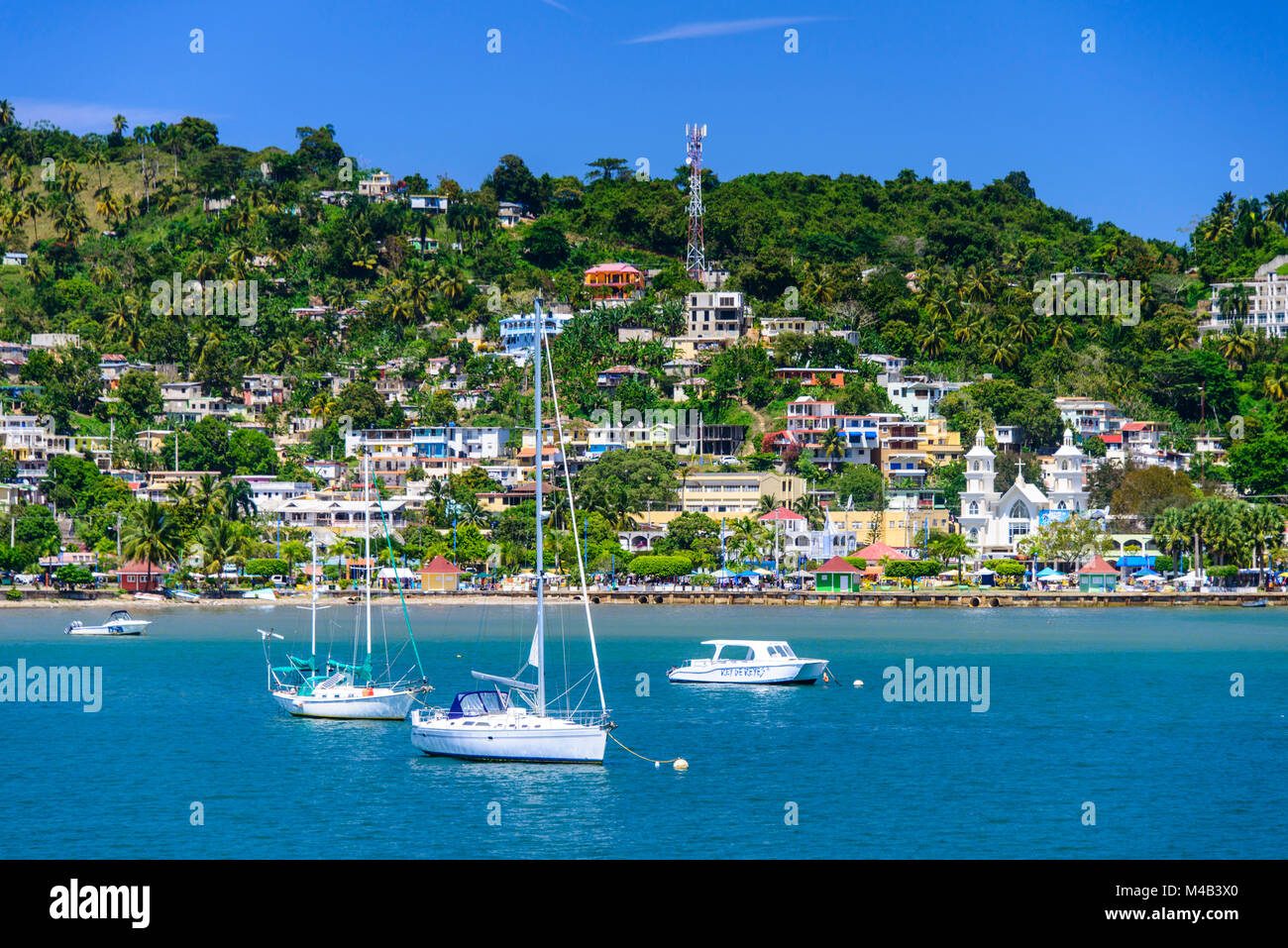
Waterfront promenade along Av. La Marina with views over Samana Bay and passing fishing boats. A common gathering spot before or after boat departures.
Small hillside church overlooking the bay, notable for its wooden construction shipped from England in the 19th century.
Long wooden pedestrian bridge stretching over the bay connecting Samana town to Cayo Vigia islet.
Central plaza in town used for local events, shaded by tropical trees and near shops and cafes.
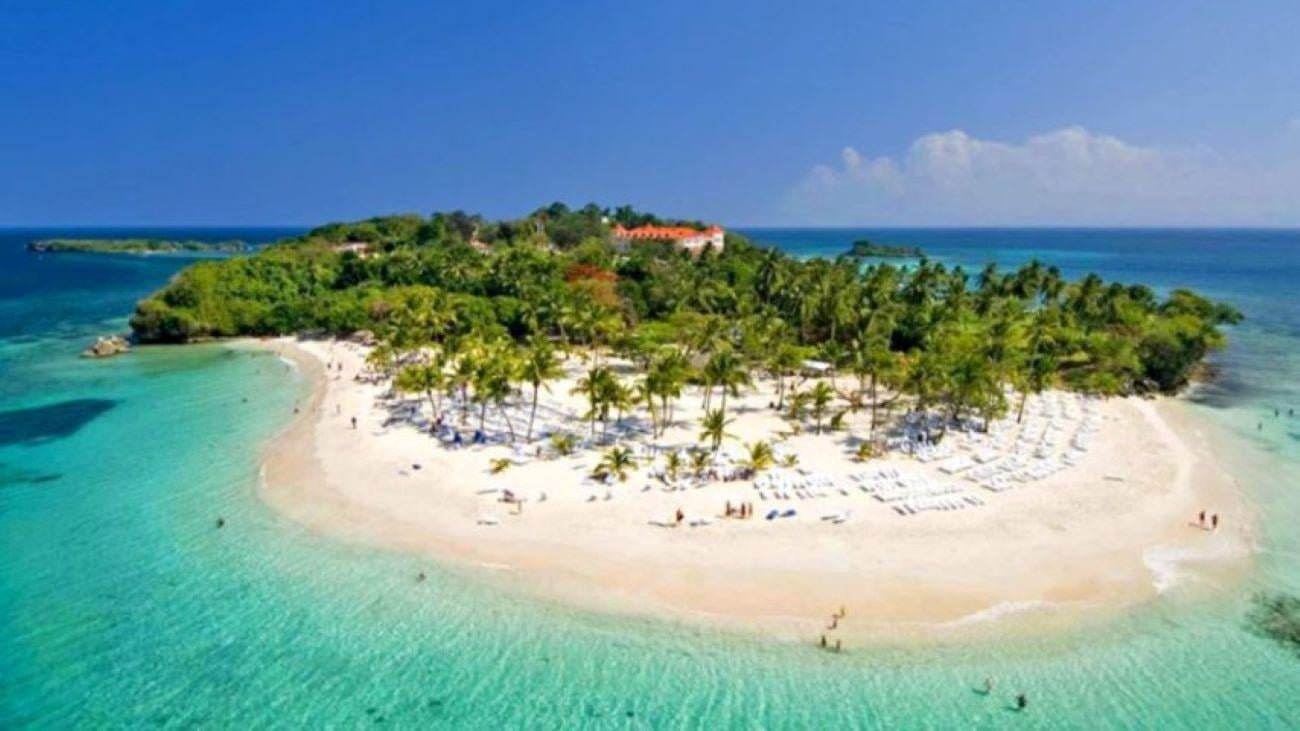
Small beach island in Samana Bay, often combined with whale watching tours for a swim and lunch stop.
Small hotels and guesthouses cluster near the Malecon and Av. La Marina, convenient for early boat departures.
Hillside resort overlooking Samana Bay with private beach access and pool terraces.
Beach town with boutique hotels and guesthouses, a common alternate base for Samana Bay excursions.
All-inclusive beachfront resort near Las Terrenas popular with whale season travelers.
Join thousands of happy travelers who have discovered this incredible experience
Book Your Experience Now